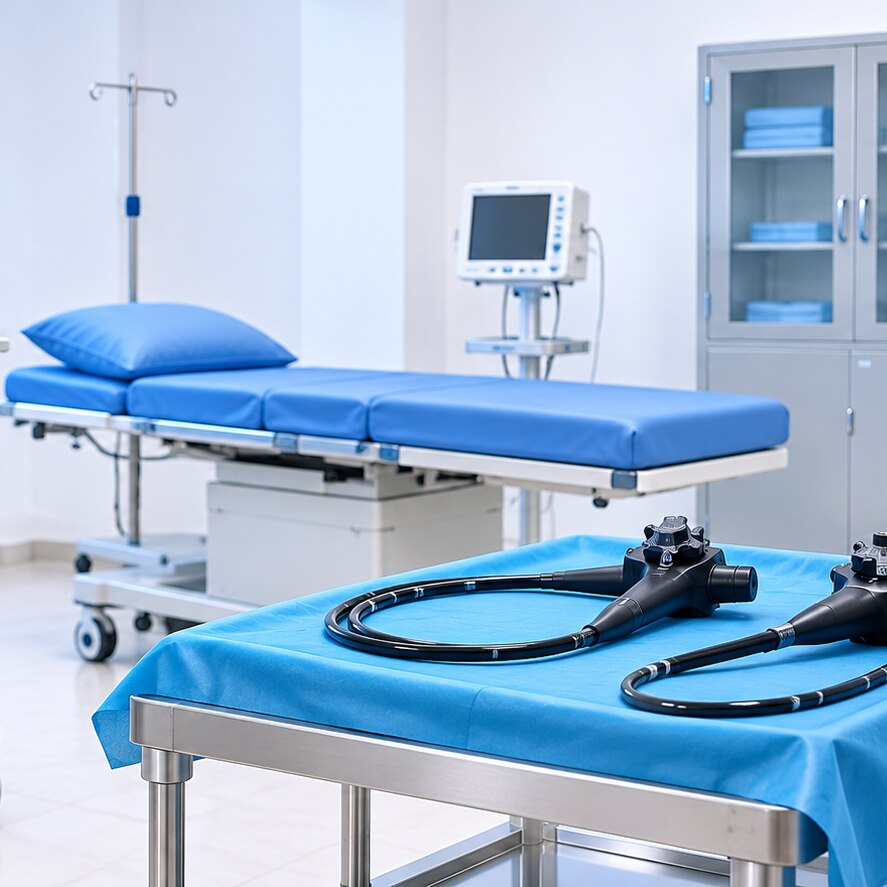
A scope that produces a sharp image can still fail your service if its channels, accessories, reprocessing system, recording platform, or repair support do not match the procedures you perform. By the end, you will have a practical framework for mapping procedures, testing compatibility, assessing safety and reprocessing, and comparing the full cost of ownership.
Key takeaways
- Match scopes and accessories to each planned procedure.
- Verify the complete image signal chain, from camera to monitor.
- Include leak testing, cleaning, disinfection, and sterilization in specifications.
- Compare service terms, downtime risk, and total lifecycle cost before payment.
Match the equipment to each procedure, not to a generic endoscopy room
A generic room is not a procedure specification. Define the anatomy, intervention, accessory access, imaging method, and reprocessing route before selecting the equipment.
| Procedure | Equipment to specify | Critical requirements |
|---|---|---|
| Diagnostic upper GI endoscopy | Gastroscope, processor, light source, suction, CO2, biopsy tools | Tip angulation, channel diameter, image quality, recording |
| Colonoscopy | Colonoscope, irrigation pump, CO2, suction, snares, electrosurgical generator | Insertion length, torque response, water-jet access, polypectomy compatibility |
| ERCP | Side-viewing duodenoscope, elevator accessories, fluoroscopy, guidewire system | Elevator cleaning method, channel access, leak test, maintenance support |
| EUS | Radial or linear echoendoscope, ultrasound processor, Doppler, needles | EUS equipment requirements include penetration, needle compatibility, image modes, and reprocessing |
| Bronchoscopy | Flexible or rigid scope, suction, lavage, biopsy tools | Channel diameter, oxygenation support, specimen handling |
| Cystoscopy | Flexible or rigid cystoscope, camera, light source, irrigation | Sterility method, sheath compatibility, irrigation control |
| Laparoscopic procedures | Rigid scopes, camera, light source, insufflator, energy devices | 0° or 30° optics, pneumoperitoneum alarms, instrument compatibility |
Diagnostic upper GI endoscopy equipment and colonoscopy equipment need different insertion lengths and handling characteristics. ERCP equipment needs a side-viewing distal end and elevator-controlled accessories, while a duodenoscope requires a validated elevator-cleaning process rather than a standard colonoscope workflow.
CO2 insufflation adds patient-comfort benefits but requires cylinders or a gas supply, compatible tubing, filters, alarms, and a defined caution policy. Include gas consumption and equipment costs in the procedure business case.
Specify the complete stack and verify the entire image signal chain
Buy a complete endoscopy stack when you need predictable compatibility, one service pathway, and rapid deployment across rooms. It is the safer choice when the scope, video processor, LED light source or xenon light source, monitor, recording system, insufflation, irrigation, and suction units must work together.
Buy separate components only when existing equipment has documented interfaces and enough remaining service life.
| Component | Verify | Failure if mismatched |
|---|---|---|
| Image sensor and optics | Native resolution, field of view, depth of field, focus, and frame rate | A 4K label produces no 4K clinical image |
| Video processor and cable | Processor output plus HDMI, 3G-SDI, 6G-SDI, or 12G-SDI compatibility | The cable or output bottlenecks resolution |
| Light source and scope | Connector, colour temperature, brightness control, and light delivery | Dark corners, colour shift, or heat at the tip |
| Monitor and recorder | Resolution, refresh rate, latency, still-image and video formats | Motion blur or a lower-quality saved record |
| Network and records | DICOM or required export, timestamps, patient context, retention, and connectivity | Metadata or enhanced-imaging modes disappear |
Demonstrate the entire signal chain using the intended scope, cable, monitor, recorder, and imaging modes. Test image uniformity, focus, white balance, light output, monitor latency, and export quality before final payment.
Record baseline results, then verify angulation, suction, irrigation, channel patency, accessory fit, and successful reprocessing-cycle completion. A named narrow-band or spectral mode is not enough; confirm that it improves the intended anatomy and remains visible in exported files.
Compare scope design, image performance, and accessory access
Compare a flexible endoscope versus rigid endoscope against the anatomy, access route, and treatment planned. A narrow-diameter or pediatric scope can reduce discomfort and reach small lumens, but its suction, accessory range, durability, and working-channel diameter are usually limited.
| Option | Compare | Trade-off |
|---|---|---|
| Flexible scope | Insertion-tube diameter, tip angulation, torque transmission, suction, and channel size | Reaches tortuous anatomy; smaller models limit suction and compatible devices |
| Rigid scope | Outer diameter, viewing angle, optics, shaft length, and sterilization method | Brighter, stable images and durable shafts; requires a straighter access path |
| 4K endoscopy | Native camera resolution, monitor resolution, focus, field of view, and light uniformity | Reveals fine detail only when every component supports 4K; it does not fix poor focus or illumination |
| 3D endoscopy | Depth perception, display compatibility, glasses or headset requirements, and surgeon preference | Helps spatial orientation; adds equipment and viewing requirements |
| Channel and controls | Working-channel diameter, actual IFU device range, wheel force, handle shape, and articulation | Larger channels improve suction and accessory choice but increase scope diameter and hand fatigue |
Check the scope with the exact biopsy forceps, snares, brushes, injection needles, and hemostasis devices you will use. Physical fit does not prove electrical compatibility: verify generator connectors, monopolar and bipolar ratings, alarms, and leakage-current testing.
Before final payment, document image uniformity, white balance, light output, angulation, suction, irrigation, channel patency, accessory exchange, and monitor-recording interoperability. Repeat the assessment during supervised procedures with gloves and the monitor in its actual position; a showroom demonstration hides fatigue and awkward control-wheel force.
Make patient safety and reprocessing part of the equipment specification
A reusable scope is not safe merely because it fits an automated endoscope reprocessor. Specify the complete endoscope reprocessing chain, then prove that the facility can perform every step without improvisation.
1. Match the scope’s instructions for use to bedside pre-cleaning, leak testing, manual brushing and flushing, detergent concentration, high-level disinfection or sterilization, rinsing, forced-air drying, storage, and transport. Confirm compatibility with the facility’s automated endoscope reprocessor, water quality, detergents, connectors, drying system, and storage cabinet. An automated endoscope reprocessor cannot compensate for inadequate manual cleaning.
2. Require measurable controls on the equipment. A CO2 insufflator needs a reliable gas supply, compatible tubing and filters, pressure and flow alarms, and a policy for patients requiring particular caution with gas insufflation. Confirm suction cut-offs, irrigation controls, electrical protection, and emergency shut-off functions before approval.
3. Validate drying and storage, not just disinfection. Check that forced-air connectors reach every channel, the cabinet supports the scope’s storage orientation, and the manufacturer’s maximum storage interval is documented. A vertical cabinet is not automatically a validated drying system; residual moisture can support microbial survival or growth.
4. For a single-use system, verify sterile-pack integrity, expiry-date control, lot traceability, accessory compatibility, and disposal of contaminated components. For either design, run an acceptance test covering leak-test results, channel patency, suction, irrigation, angulation, and successful completion of the facility’s full reprocessing cycle. Record the baseline before final payment.
Compare reusable and single-use options using procedure volume, reprocessing failure rate, labour, water, chemicals, repairs, waste disposal, and turnaround time—not purchase price alone.
Calculate lifecycle cost, service support, and acceptance before final payment
Do not release final payment until the system passes endoscope acceptance testing and its support costs are documented. A low purchase price can become expensive when a failed scope stops a procedure list, requires emergency rental equipment, or waits weeks for a repair.
1. Build a five-year cost model using the facility’s annual procedure volume. Include purchase price, single-use accessories, reprocessing labour, water, detergent, leak testing, drying and storage, preventive maintenance, repairs, software upgrades, cybersecurity work, spare parts, CO₂ gas, waste disposal, and eventual replacement.
Compare reusable and single-use options using your actual case volume and reprocessing failure rate.
2. Put service-level commitments in the contract, not only a warranty. Specify preventive-maintenance intervals, leak-test and angulation checks, endoscope repair turnaround, loaner availability, replacement of damaged distal covers, software support, cybersecurity response, spare-parts availability, and the process for a scope found faulty after a procedure.
Ask Windlio International, or any supplier, to identify who performs each task and where repairs occur.
3. Test every installed link: scope, processor, video cable, light source, monitor, recorder, and DICOM endoscopy recording. Check image uniformity, focus, white balance, light output, angulation, suction, irrigation, channel patency, accessory fit, alarms, and reprocessing-cycle compatibility.
4. Record the acceptance measurements and obtain signed results before payment. Use them as the baseline for endoscopy equipment maintenance, warranty disputes, and diagnosing deterioration caused by wear or reprocessing damage.
Frequently asked questions
Why should endoscopy equipment match each procedure?
Different procedures require different anatomy access, intervention tools, imaging methods, scope designs, and accessory pathways. Specify these needs before choosing a room-wide system.
What should you verify in an endoscopy image signal chain?
Check the scope camera, processor, light source, cables, connectors, monitor, and recording system as one chain. Confirm that each component supports the required resolution, video format, inputs, and outputs.
How should you compare endoscopes and accessories?
Compare scope diameter, working-channel size, tip angulation, field of view, image performance, and the space available for accessories. Confirm that planned instruments pass through the channel and reach the treatment site.
Why must reprocessing be included in the equipment specification?
Specify leak testing, manual cleaning, high-level disinfection or sterilization, drying, storage, and traceability requirements alongside the equipment. A scope that cannot fit your reprocessing route creates a patient-safety and workflow problem.
What should you assess before making final payment?
Calculate purchase, installation, training, consumables, maintenance, repairs, downtime, and replacement costs. Complete acceptance testing and verify service coverage, documentation, accessories, and performance before final payment.