
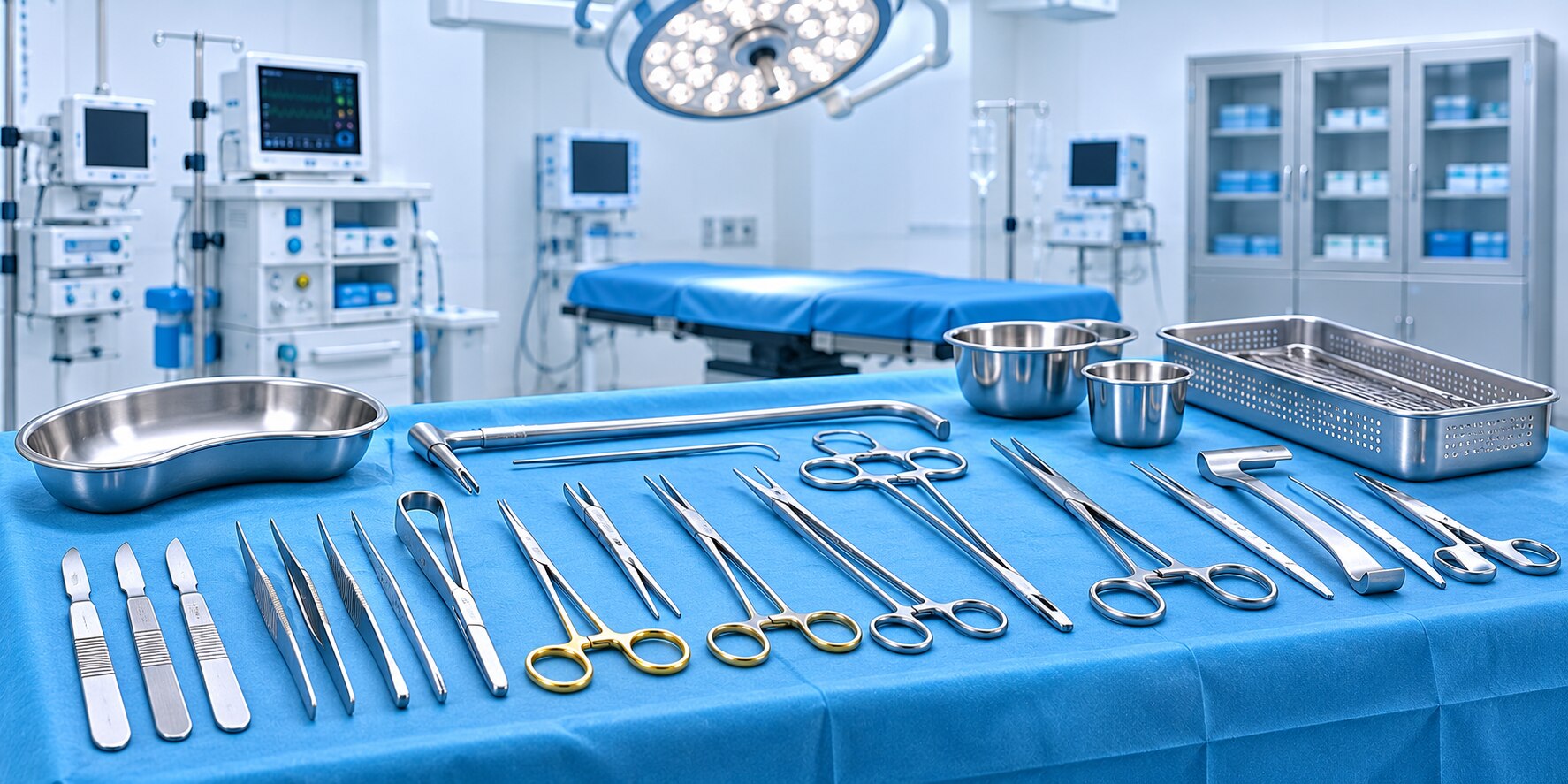
A modern operating room needs more than a tray of scalpels and forceps. You need to match each instrument to the tissue, access route, procedure, energy system, sterilization method, and counting workflow. By the end, you will have a practical framework for building procedure-specific sets and evaluating reusable, single-use, powered, and specialty devices.
Key takeaways
- Match instruments to tissue, access route, incision depth, and surgical task.
- Use No. 3 handles for smaller blades and No. 4 handles for larger blades.
- Add cameras, trocars, energy devices, and handpieces to procedure-specific sets.
- Track decontamination, inspection, sterilisation, and tray contents by role.
What belongs in the core surgical instrument set?
A core set covers incision, grasping, haemostasis, cutting, exposure, suction, closure, and specimen handling. Choose each instrument by tissue, access route, incision depth, and task—not by name alone. Your surgical instruments list should include scalpels and handles: a No. 3 handle with compatible smaller blades and a No. 4 handle with larger blades.
| Group | Instruments | Choose by tissue, access, and task |
|---|---|---|
| Cut and grasp | Adson and DeBakey forceps; toothed tissue forceps; dressing forceps; Mayo and Metzenbaum scissors | Fine, atraumatic DeBakey jaws suit vessels; teeth hold skin or fascia. Dressing forceps handle gauze. Straight scissors work in accessible planes; curved scissors follow deeper planes. Hand dominance and handle design affect wrist control. |
| Clamp and close | Mosquito and Kelly hemostats; Kocher clamps; Mayo-Hegar needle holders; towel clamps; sponge-holding forceps | Mosquito suits small vessels, Kelly larger pedicles, and Kocher firm tissue. Match jaw pattern and needle-holder length to the incision. |
| Expose and evacuate | Army-Navy and Deaver retractors; Yankauer and Poole suction tips | Army-Navy suits shallow exposure; Deaver reaches deep cavities. Yankauer handles focused suction; Poole drains fluid across a broader field. Check shaft diameter and working length for restricted access. |
The phrase “hemostatic clamps and forceps types and uses in surgery? Wait no question?” is answered by tissue size and required grip: excessive force crushes vessels, while fine jaws lose control in thick fascia. Inspect sharp edges, jaw alignment, ratchet engagement, smooth box locks, lumen patency, and freedom from corrosion or retained soil before use.
How should instruments be mapped to each procedure family?
Build a procedure-by-procedure tray checklist; one universal set cannot cover tissue planes, access routes, or implant systems safely.
1. General surgery instruments should cover basic dissection, ligation, retraction, suction, and specimen handling. Add scalpels, tissue and dressing forceps, hemostats, needle holders, retractors, Yankauer or Poole suction tips, sponge forceps, specimen forceps, and labelled specimen containers.
2. Orthopedic surgical instruments need bone levers, periosteal elevators, osteotomes, mallets, reduction forceps, rongeurs, drills, saws, and implant-specific instruments. Match each tray to the procedure and implant system, not merely to the specialty.
3. Gynecology instruments should include vaginal retractors, uterine manipulators, sponge forceps, tenacula, cervical dilators, and endometrial sampling tools. Separate diagnostic, vaginal, laparoscopic, and operative configurations so unused instruments do not obscure missing ones.
4. Vascular surgery instruments require DeBakey forceps, Potts-Smith scissors, angled vascular clamps, bulldog clamps, vessel loops, and fine needle holders. Their atraumatic jaws and controlled pressure protect fragile vessels.
5. ENT instruments include bayonet forceps, alligator graspers, nasal specula, suction tips, curettes, and delicate retractors. Choose tip size and working length for the ear, nose, throat, or sinus approach.
Dedicated specialty surgical sets reduce substitutions, omissions, and tissue damage during urgent cases. Implants require their own compatible drivers, guides, trial components, inserters, and extraction tools, plus implant lot numbers, size records, and instrument compatibility documentation. A tray is complete only when the procedure, anatomy, implant, and traceability record align.
Which devices complete a laparoscopic, energy, or powered set?
A complete laparoscopic, energy, or powered set combines reusable stainless-steel instruments with single-use devices, powered handpieces, energy instruments, implants, and accessories. They work together only when shaft dimensions, interfaces, generators, batteries, and processing methods match.
| Category | Typical contents | Control point |
|---|---|---|
| Reusable instruments | Steel graspers, dissectors, scissors | Inspect jaws, insulation, box locks, and validated sterilization |
| Single-use devices | Specimen bags, some trocars and clip appliers | Confirm size, seal, expiry, and disposal route |
| Powered handpieces | Orthopedic drills, saws, and motors | Match battery, attachment, blade, burr, torque, speed, and sterilization limit |
| Energy instruments | Monopolar and bipolar electrosurgery | Verify waveform, connector, and generator compatibility |
| Implants | Plates, screws, meshes, and prostheses | Keep separate with implant-specific drivers, guides, trials, and records |
| Accessories | Light cables, return electrodes, tubing, batteries | Check interface, sterility, and patient-use status |
Specify a laparoscopic set with a camera and telescope, light cable, 5 mm or 10 mm trocars, defined working length, rotating graspers and dissectors, atraumatic and toothed jaws, laparoscopic scissors, clip appliers, suction irrigation instruments, specimen bags, and monopolar or bipolar devices.
- Monopolar electrosurgery sends current through the patient and requires a patient return electrode; bipolar jaws confine the circuit between their jaws.
- For orthopedic powered surgical instruments, check torque, speed, battery chemistry, sterile-battery handling, blades, burrs, attachments, handpiece interface, and steam or low-temperature sterilization limits. Treat implants and their tools as separate inventory, not ordinary tray instruments.
How do reprocessing and operating-room roles keep instruments safe and accounted for?
Safety begins before the tray reaches the operating room and ends only after documented surgical counts and traceability are complete.
1. Sterile processing staff follow the device-specific ISO 17664-1:2021 instructions. They remove blood, bone, and tissue during instrument cleaning and inspection, then check box-locks, serrations, lumens, insulation, corrosion, and function; lubricate, package, sterilize, and release the tray.
2. Apply Spaulding classification: instruments entering sterile tissue or the vascular system are critical and require sterilization; devices touching intact mucous membranes are semicritical and require at least high-level disinfection. For heat-tolerant devices, validated steam examples include 121°C gravity displacement for 30 minutes or 132°C prevacuum for 4 minutes. The device IFU takes precedence.
3. The scrub nurse selects the approved tray, checks instrument function, passes instruments, and participates in counts. The circulating nurse verifies counts with the scrub nurse, documents implants and specimens, manages additions, coordinates safety checks, and scans UDI or lot numbers for traceability.
4. The surgeon states tissue and access requirements and confirms instrument, sponge, and needle counts before closure. The anesthetist coordinates equipment needs without disrupting the sterile field.
5. Repeat surgical counts before the patient leaves the room. Investigate discrepancies immediately; do not rely on a later tray check to correct a missing instrument, sponge, or needle.
How should you compare reusable instruments, single-use devices, and suppliers?
Choose reusable versus single-use surgical instruments by total clinical burden, not purchase price. Reusables win when repeated procedures justify validated cleaning, inspection, repair, and sterilization capacity; single-use devices win when a complex lumen, insulation, battery, coating, or urgent case makes reprocessing impractical. Reuse also demands cross-contamination controls and traceability from tray to patient.
| Option | Clinical performance and contamination control | Workload and replacement |
|---|---|---|
| Reusable | Consistent handling; validated processing reduces contamination risk | Cleaning, inspection, repair, sterilization, and eventual replacement |
| Single-use | Ready for urgent or high-risk applications; no patient-to-patient reuse | Higher recurring replacement effort; confirm disposal and accessory supply |
| Supplier | Match geometry, materials, generators, and accessories | Judge service, reprocessing IFU, repairability, and traceability |
Your surgical instrument supplier evaluation must require:
- Material grade, heat treatment, passivation, surface finish, jaw geometry, working length, shaft diameter, connector type, generator compatibility, and maximum reuse or inspection limits. Specify surgical stainless steel 410, 420, or 316L rather than accepting “surgical steel.”
- Reject instruments with rough hinges, weak ratchets, misaligned jaws, inaccessible box locks, blocked serrations, or incomplete reprocessing IFU documentation. Make surgical instrument quality inspection part of incoming acceptance.
- Request device-specific processing instructions, scannable identifiers, repair support, compatible accessories, and sample inspection records. Windlio International belongs in a wider hospital-equipment comparison only when its service evidence also meets these instrument requirements.
Frequently asked questions
What belongs in a core surgical instrument set?
Include instruments for incision, grasping, haemostasis, cutting, exposure, suction, closure, and specimen handling. A basic scalpel selection includes a No. 3 handle for smaller blades and a No. 4 handle for larger blades.
How should instruments be mapped to each procedure family?
Map instruments to the tissue, access route, incision depth, and task for each procedure family. Build separate requirements for open, laparoscopic, endoscopic, orthopaedic, and microsurgical work rather than using one generic tray.
Which devices complete laparoscopic, energy, or powered sets?
Laparoscopic sets require compatible scopes, cameras, light cables, trocars, graspers, dissectors, suction-irrigation tools, and specimen retrieval options. Energy sets require the generator, handpiece, electrodes or vessel-sealing instruments, and compatible cables. Powered sets require the handpiece, drive attachments, blades or burrs, irrigation, and foot control where specified.
How do reprocessing and operating-room roles keep instruments safe and accounted for?
Assign clear responsibility for point-of-use treatment, transport, cleaning, inspection, assembly, sterilisation, storage, and count verification. Check hinges, serrations, insulation, tips, lumens, and the tray count before release.
How should you compare reusable instruments, single-use devices, and suppliers?
Compare purchase cost with cleaning, repair, sterilisation, replacement, training, and downtime. Ask suppliers for material details, compatibility information, instructions for use, traceability records, service terms, and samples for inspection.