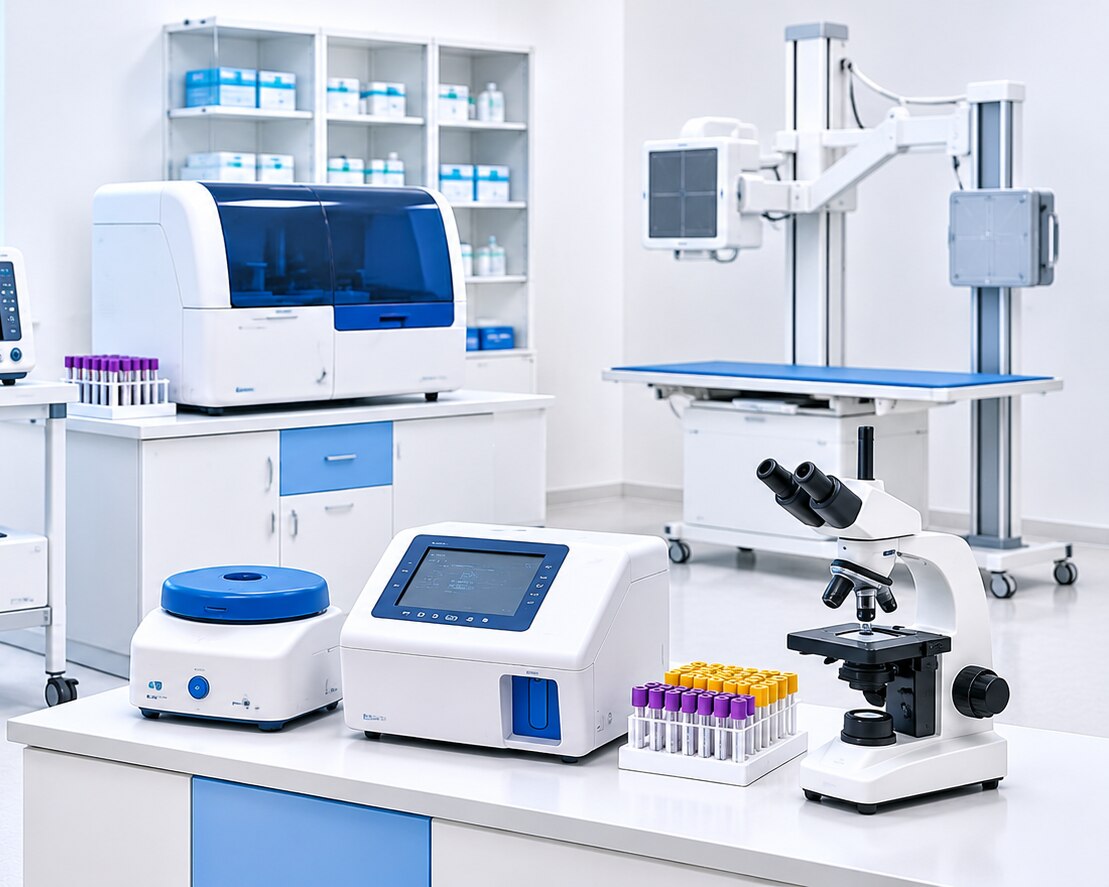
A device is only useful when its measurement answers the clinical question, fits the patient population, and performs reliably in the intended workflow. By the end, you will be able to compare diagnostic categories, specify the measurements and operating conditions that matter, and identify accuracy, maintenance, and documentation gaps before purchase.
Key takeaways
- Define the clinical question before comparing device features.
- Match monitor parameters and specifications to patient acuity.
- Assess ECG equipment by waveform quality and intended clinical use.
- Include workflow, servicing, safety, and real-world accuracy in procurement specs.
Start with the clinical question, not the device catalogue
Choose the measurement that will change your next clinical action. Screening asks whether a problem might be present; monitoring tracks change over time; diagnosis confirms or characterises a condition. Those jobs require different diagnostic equipment categories, even when they measure the same physiological signal.
| Clinical question | Suitable equipment | Decision it supports |
|---|---|---|
| Screening for immediate abnormality | Blood-pressure devices, thermometers, pulse oximeters, glucometers | Whether to repeat, refer, or escalate |
| Monitoring an unstable or treated patient | Vital-sign monitors | Whether the patient is improving, deteriorating, or needs intervention |
| Confirming a suspected condition | ECG machines, spirometers, ultrasound systems, laboratory analyzers | Whether findings support a diagnosis or further testing |
Match the choice to the patient population, department, acuity, and required measurement range. For blood pressure, require an independent clinical-validation record for the exact device and cuff configuration, such as ISO 81060-2:2018; validation of one cuff size does not cover another.
For thermometers, compare rectal, oral, axillary, temporal, or tympanic performance at the intended site, because those readings are not interchangeable.
Treat ECG machine interpretation as an aid, not a verdict. Select a system that records diagnostic-quality waveforms and flags lead-off or signal-quality problems; loose electrodes, tremor, mains interference, lead reversal, or high V1–V2 placement can create false findings.
Also ask how calibration is verified, whether maintenance is traceable, and whether the equipment meets applicable IEC 60601-1 electrical-safety requirements.
Choose monitor parameters and specifications that match patient acuity
A 3-parameter patient monitor is sufficient for stable patients who need heart rate or ECG rhythm, SpO2, and non-invasive blood pressure or NIBP, including routine ward observation, short-stay recovery, and transport. It becomes inadequate when temperature, respiratory trends, or gas exchange will alter treatment.
| Option | Measurements | When it fits |
|---|---|---|
| 3-parameter patient monitor | ECG or heart rate, SpO2, NIBP | Stable patients needing basic observation and intermittent vital-sign checks |
| 5-parameter patient monitor | ECG or heart rate, SpO2, NIBP, temperature, respiration | Emergency, postoperative, step-down, and unstable patients needing broader trending |
| Additional capability | EtCO2, invasive pressure, cardiac output, or multiple temperatures | Ventilated or sedated patients, invasive monitoring, anesthesia, and critical care |
Do not treat a 5-parameter patient monitor as a substitute for capnography. Respiration derived from ECG impedance can show a rate trend, while EtCO2 confirms exhaled carbon dioxide and helps detect apnea, hypoventilation, or circuit problems.
Specify the measurement details that affect decisions:
- Require adult, pediatric, or neonatal ranges and sensors when those patients are in scope.
- Set alarm limits, NIBP intervals, trend duration, and screen visibility to match the observation period.
- Request independent clinical validation for the exact NIBP model and cuff configuration under ISO 81060-2:2018.
- Buy cuffs covering the usable arm-circumference range; a small cuff overestimates pressure, while an oversized cuff underestimates it.
Specify ECG equipment by waveform quality and clinical use
A resting 12-lead ECG and bedside rhythm monitoring serve different decisions: the first captures a diagnostic snapshot, while the second tracks rhythm and rate over time. Compare waveform purpose, lead configuration, sampling rate, storage, and review workflow—not display size alone.
| Option | Waveform and configuration | Best clinical use |
|---|---|---|
| Resting 12-lead ECG | Diagnostic-quality simultaneous 12-lead acquisition, with a sampling rate of at least 500 samples per second for ST-segment and interval analysis; standard limb and precordial lead configuration | Chest pain, ischemia or infarction assessment, conduction defects, axis, and baseline documentation |
| Bedside rhythm monitoring | Continuous one- or five-lead display prioritised for QRS and rhythm detection, with documented sampling rate and filtering for uninterrupted monitoring | Arrhythmia surveillance, rate changes, alarm response, and acute-care observation |
A monitor’s automatic statement is an aid, not a diagnosis. Loose electrodes, muscle tremor, mains interference, poor skin preparation, lead reversal, and misplaced V1–V2 electrodes can create false ST-T changes or apparent septal infarction. Require lead-off and signal-quality alerts, clear lead-wire identification, placement aids, and clinician review of the recorded tracing.
Do not substitute bedside rhythm monitoring for a diagnostic ECG when morphology matters. Conversely, a 12-lead machine does not replace continuous alarms for an unstable patient. Verify waveform storage, timestamp accuracy, digital export, alarm audibility, and clinical-record compatibility before approval.
Judge accuracy claims under real patient and operating conditions
Treat an accuracy claim as credible only when independent evidence covers the exact device configuration, patient population, measurement site, and workflow you will use. A laboratory specification does not prove reliable readings during transport, movement, poor perfusion, or repeated bedside measurements.
Ask the supplier for:
- An independent clinical-validation record for the exact blood-pressure model and cuff size, using ISO 81060-2:2018 or another named recognized protocol. Validation of one cuff configuration does not cover every cuff size.
- A clearly marked usable arm-circumference range. A cuff that is too small can overestimate pressure; one that is too large can underestimate it.
- Accuracy evidence for the intended thermometer site. Rectal, oral, axillary, temporal, and tympanic readings are not interchangeable, and tympanic accuracy depends on probe position and a clear ear canal.
- Pulse-oximetry testing that addresses motion artifact, poor peripheral perfusion, venous pulsation, nail products, ambient light, and dyshemoglobinemia. Require a visible signal-quality indicator and waveform where available.
- The operating measurement range, alarm limits, alarm audibility, and behavior during signal loss or out-of-range readings.
Test representative patients and routine tasks before approval. Include movement, transfers, repeat measurements, cleaning, battery operation, and the accessories staff will actually use. Check IEC 60601-1 applicability, leakage-current protection, protective earth, approved power supplies and batteries, and cleaning compatibility.
A device that produces accurate numbers only under still, ideal conditions is not accurate enough for your workflow.
Build the procurement specification around workflow, service, and safety
A purchase is not ready for approval until its accessories, cleaning method, calibration plan, electrical protection, service response, and paperwork fit the way staff will use it.
1. Confirm the complete working configuration. Specify approved power supplies, batteries, cables, sensors, cuffs, probe covers, printer paper, and mounting hardware. For glucometers and laboratory analyzers, price test strips, reagents, controls, storage conditions, expiry dates, and waste handling.
For an examination couch, check safe working load in the highest lift and backrest positions, side-rail loads, transfer forces, and patient-lift compatibility; static patient weight is not enough.
2. Match cleaning to the procedure. Ultrasound systems need probes that tolerate your validated disinfectant: intact skin usually requires low-level disinfection, while mucous membranes or non-intact skin require high-level disinfection and a compatible cover. For tympanic thermometers, include single-use covers or validated between-patient disinfection, plus the labour and battery cost.
3. Require a calibration and verification schedule naming the standard, interval, method, acceptance limits, and responsible party. Compare thermometers at the intended site—oral, rectal, axillary, temporal, or tympanic—not against interchangeable readings. Request independent ISO 81060-2:2018 validation for each blood-pressure device and cuff configuration.
4. Check IEC 60601-1 conformity, leakage-current protection, protective-earth arrangements, alarm audibility, ingress rating, and approved batteries. Do not substitute a generic adapter.
5. Get serial-numbered manuals, certificates, software requirements, warranty terms, preventive-maintenance intervals, spare-parts availability, training, response times, loaner arrangements, and disposal instructions in writing. Ask Windlio International to supply this evidence with the quoted configuration, not after delivery.
Related products
 | Medical Equipment 5 Para Patient Monitor Manufactured by Windlio International The 5 Parameter Multiparameter Patient Monitor is a high-performance, real-time... View product → |
 | Medical Equipment Manufactured by Windlio International, Pune The 3 Parameter Patient Monitor is a compact, user-friendly, and highly portable monitoring device... View product → |
Frequently asked questions
How should you begin choosing diagnostic equipment?
Start with the clinical question: decide whether you need screening, trend monitoring, diagnosis, or condition characterisation before selecting a device category.
Which monitor specifications should match patient acuity?
Match measured parameters, alarm performance, display information, and measurement ranges to the patient’s clinical risk and required observation frequency.
How do you compare ECG equipment?
Compare waveform quality, lead configuration, intended clinical use, recording and review functions, and compatibility with your workflow rather than relying on feature count.
How can you judge diagnostic equipment accuracy?
Review accuracy claims under relevant patient conditions and operating environments, then include calibration, servicing, safety checks, and workflow requirements in the procurement specification.
Related product
 | Monitor Trolley MS 3 Shelves ECG Machine Trolley Manufactured by Windlio International, Pune The MS 3 Shelves ECG Machine Trolley is a high-quality, hospital-grade equipment transportation cart... View product → |