An organized operating theatre depends on more than an operating table and a few storage units. You need to distinguish furniture from clinical equipment, map every movement route, compare technical specifications, and test the complete setup before handover.
Key takeaways
- Keep anesthesia equipment outside sterile zones and clear of emergency routes.
- Choose an operating table for stability, access, positioning, imaging, and cleaning.
- Specify closed storage, lockable trolleys, sealed surfaces, and foot-operated waste bins.
- Check dimensions, load ratings, materials, accessories, and documentation before acceptance.
What Furniture Belongs in Each Operating-Theatre Zone?
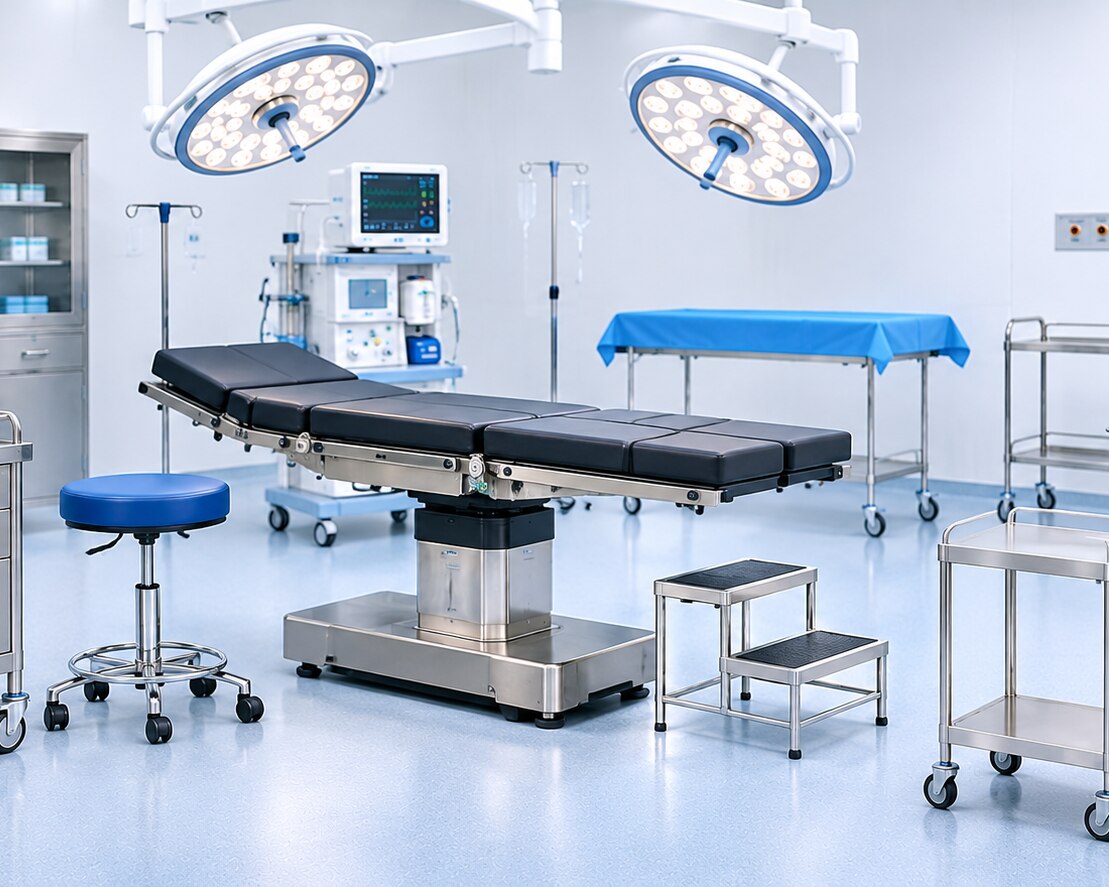
Operating theatre furniture is assigned by zone: the operating table anchors the surgical field, while stools, tables, bins, cabinets and trolleys support each team member without entering sterile or emergency routes.
The practical distinction is medical equipment versus furniture: an anesthesia machine, patient monitor, electrosurgical unit, suction unit, OT light and ceiling pendant are equipment or infrastructure; furniture holds, positions or moves people and supplies.
| Zone | Essential furniture and support items | Equipment distinction |
|---|---|---|
| Operating field | Operating table, surgeon stool, assistant stool, Mayo stand, positioning equipment | The table supports the patient; lights, monitors and electrosurgical units are equipment |
| Sterile instrument zone | Instrument table, back table and kick bucket | The tables hold sterile supplies; the instrument set and suction device are equipment |
| Anesthesia zone | Anesthesia workstation support, waste bin and a clear access side for the anesthesia provider | The anesthesia workstation and gas delivery system are equipment |
| Circulation and storage | Surgical step stool, linen bin, storage cabinet and patient transfer trolley | Transfer and storage furniture moves patients or supplies; the patient monitor remains equipment |
Specify seat height adjustment for the surgeon and assistant so both can work without leaning over the field. Give every mobile item a safe working load, caster diameter, wheel material, brake arrangement and turning radius; an off-centre tray can tip a trolley below its stated load.
Keep waste and linen bins outside sterile work areas, and confirm drawer, door and trolley clearance with the table fully lowered, tilted and accessorized. Furniture that fits a drawing can still block evacuation or emergency access.
How Should You Arrange the Table, Anesthesia Zone, and Sterile Work Areas?
Start with the operating table, then build outward: anesthesia at the head, sterile work areas beside the surgical field, and a continuous perimeter route for staff and emergencies. This operating theatre layout must work with the table lowered, tilted, accessorized, and surrounded by carts.
1. Mark the table’s full footprint, including its wheelbase, mattress, side rails, positioning accessories, and maximum tilt. Keep the transfer route from the door to the table unobstructed, and verify door clearance and corridor turning space with the actual patient trolley.
2. Place the anesthesia zone at the head end, with the anesthesia machine, monitor, gas outlets, sockets, and suction within reach. Keep hoses and cables off the floor; confirm ceiling pendant reach without crossing the surgeon position, lights, or emergency access.
3. Set the scrub nurse position beside the table near the sterile instrument zone. Place the Mayo stand and back table where instruments pass directly to the field, while keeping the surgeon position and assistant position clear of trolley corners and pendant arms.
4. Reserve the circulating nurse route around the nonsterile perimeter. Position the equipment trolley, waste bins, and linen bins outside the sterile path, and prevent drawer swings or open doors from narrowing the route.
5. Test clean flow from storage to the sterile instrument zone, and dirty flow from the used-instrument area toward the exit without crossing clean supplies. For C-arm cases, check C-arm clearance around the table, imaging windows, cables, and pendant columns before fixing furniture positions.
Which Operating-Table Specifications Affect Surgical Safety?
Choose the table mechanism for the procedure, power-failure plan, and positioning frequency. A hydraulic operating table suits straightforward cases with limited powered adjustment; an electro-hydraulic operating table gives controlled height and tilt under load; an electro-mechanical operating table supports precise, repeatable movement. A manual operating table reduces electrical complexity but demands staff effort.
For powered models, require IEC 60601-2-46 evidence, a hand control, emergency positioning, and battery backup.
| Option | Best fit | Check before purchase |
|---|---|---|
| Hydraulic operating table | General surgery with modest adjustment | Pump access, lock stability, and height range |
| Electro-hydraulic operating table | High-use rooms and heavier patients | Motor noise, battery backup, and brake response |
| Electro-mechanical operating table | Frequent articulation and imaging | Actuator clearance, hand control, and IEC 60601-2-46 documentation |
| Manual operating table | Low-complexity procedures or backup use | Staff effort, emergency movement, and castor locks |
Calculate safe working load for the complete setup, not the patient alone. Add mattress weight, side rails, arm supports, leg holders, traction devices, imaging accessories, and leverage from tilt or articulation; bariatric surgery requires a tested reserve, not a nominal label.
Specify height range, longitudinal travel, lateral travel, back articulation, and leg articulation against each procedure. Confirm Trendelenburg and reverse Trendelenburg angles, plus lateral positioning without accessory interference. For orthopaedics, compare a fracture table with traction devices and a radiolucent tabletop whose C-arm imaging window remains usable; columns, clamps, and rails can still block the beam.
How Do You Specify Trolleys, Storage, Lights, and Cleaning-Ready Support Furniture?
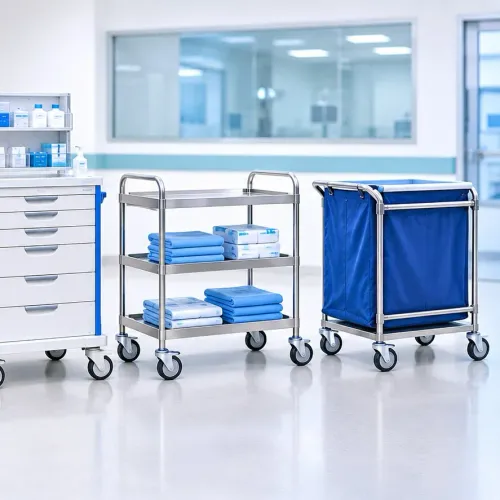
Specify each support item by failure mode, not appearance. A Mayo stand safe working load must include high, off-centre trays; compare an instrument trolley and mobile equipment trolley for caster diameter, wheel material, brake performance, turning radius, and stability under actual loads. Verify the shelf load limit separately.
| Category | Compare | Why it matters |
|---|---|---|
| Construction | Type 304 stainless steel with Type 316L stainless steel where chloride exposure is severe; require radiused corners, welded joints, sealed cushions, protected casters, and disinfectant compatibility. | Crevices and incompatible finishes retain soil or fail during cleaning. |
| Storage | Choose a closed sterile cabinet for wrapped packs; open shelving is not equivalent. Provide stock rotation and inspect pack clearance. | Overfilled storage crushes packaging and increases recontamination risk. |
| Services | Match a fixed wall service column and ceiling service pendant to the monitor arm, cable management, power sockets, socket rating, medical gas outlet, and data port required. | Poor routing creates trip hazards, hose strain, and inaccessible connections. |
| Lighting | Compare IEC 60601-2-41 compliance, surgical light illumination, color rendering, and light-field diameter at working distance. | LED wattage alone does not prove usable light or shadow control. |
Ask for IEC 60601-1 documentation covering protective earth, leakage current, electromagnetic compatibility, battery behavior, and loss of mains power. Test the complete room with the actual mattress, C-arm, anesthesia machine, carts, and positioning accessories; check collision clearance, pendant reach, emergency positioning, cable and hose routing, and cleaning access.
What Should You Verify Before Ordering and Accepting the OT Furniture?
Before operating-room furniture procurement, measure the narrowest door width, corridor turning space, table footprint, wheelbase measurement, drawer swing, cabinet door swing, and ceiling height. Mark the unobstructed route to the anesthesia side, emergency exit, and transfer area with the table lowered, tilted, accessorized, and surrounded by carts.
- For every ceiling-mounted light or pendant, obtain the structural mounting plate detail, anchor system specification, allowable seismic load, and combined pendant load for monitors, gas hoses, arms, and electrical accessories.
- Require manufacturer documentation covering IEC 60601-1 risk controls, protective earth, leakage current, electromagnetic compatibility, battery behavior, mains failure, and emergency positioning. “Medical” furniture alone does not prove electrical safety.
- Check cleaning instructions against your actual disinfectant, disinfectant contact time, and sporicidal product. Chlorine and oxidizing agents can damage finishes, labels, elastomers, and plastics.
- Ask Windlio International hospital setup solutions to reconcile furniture dimensions, service connections, and installation interfaces with the room drawings.
| Verification stage | What to test or request | Failure prevented |
|---|---|---|
| Pre-delivery | Drawings, load data, materials, warranty, cleaning instructions, and manufacturer documentation | Wrong fit or unsupported mounting |
| Installation | Protective earth, leakage current, socket polarity, gas and data connections, anchor torque, and cable routing | Shock, disconnection, or floor hazards |
| Full-room acceptance test | Actual mattress, side rails, C-arm, anesthesia machine, carts, lights, and pendants; test travel, brakes, reach, collision clearance, emergency power, and emergency positioning | Obstructed access or unsafe movement |
| Handover | Disinfectant compatibility, access for cleaning, training records, and signed results | Damage, failed cleaning, or disputed responsibility |
Related products
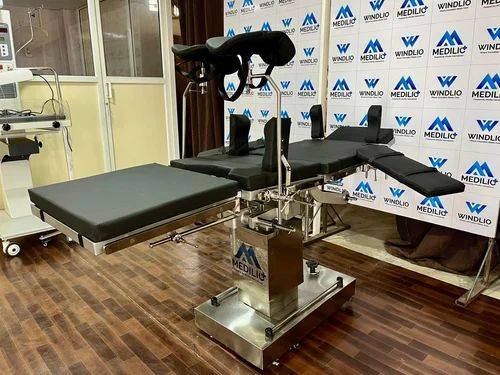 | Hospital Furniture Manufactured by Windlio International, Pune The General OT Table by Windlio International is a high-performance, multi-purpose operating table... View product → |
 | Examination Table Orthopedic Ot Table Electro Manual Hydraulic Orthopedic OT Table – Electro Manual Hydraulic Manufactured by Windlio International, Pune The Orthopedic OT Table – Electro Manual Hydraulic is a... View product → |
Frequently asked questions
What furniture belongs in each operating-theatre zone?
The operating zone needs the surgical table and sterile instrument tables. The anesthesia zone needs an anesthesia workstation, monitoring support, and stools. Peripheral zones use storage cabinets, utility trolleys, waste bins, and staff seating without obstructing circulation.
How should you arrange the operating table, anesthesia zone, and sterile work areas?
Center the operating table within clear surgical and emergency access routes. Place anesthesia equipment at the head end with direct access to the patient and wall services. Position sterile worktables where staff can reach instruments without crossing non-sterile traffic.
Which operating-table specifications affect surgical safety?
Check safe working load, height range, lateral tilt, Trendelenburg movement, section adjustment, mattress thickness, patient restraints, castors, brakes, radiolucent sections, and compatibility with imaging equipment.
What should you verify before ordering and accepting OT furniture?
Confirm room dimensions, door widths, load ratings, materials, weld quality, castor performance, electrical requirements, accessories, cleaning instructions, warranty terms, manuals, and delivery inspection records.
Related products
 | Hospital Furniture Equipment Trolley with Power Socket Panel – Multi Shelf Medical Monitor Cart on Wheels Multi-purpose hospital equipment trolley specially designed for ICU, OT, and critical care areas to safely hold monitors, ventilators, infusion... View product → |
 | OT LIGHT Dual Dome LED OT Surgical Light Product Description High-performance dual dome LED surgical light designed for modern operation theatres. View product → |